
Reconnecting Organizational Divides: Restoring Alignment into the Siloed Structures
“Every system is perfectly designed to get the results it gets.”
W. Edwards Deming
Introduction
At some point, all organisations find themselves in a situation where they are not functioning at a satisfactory level of performance. At that moment, they are facing similar challenges – how to organise employees to produce the desired results most efficiently, how to break down the silos mentality between organisational units and make the processes run smoothly, how to establish the balance between decisions being made centrally and those that should happen at the periphery, etc. These challenges can be overcome through the process of organisation design. However, there is an important misconception that needs to be addressed first.
Organisation design misconception
Designing organisation in practice usually comes down to designing the structure in the static sense – both macro and detailed organisation structure design focus on division of labour with accompanying responsibilities, and grouping of positions into organisational units. Division of labour slices up the overall work of an organisation into a set of distinct work packages resulting in defined individual positions with accompanying job descriptions. At the same time, the grouping of positions leads to defining organisational units, which serve as an integrating mechanism that implicitly fosters coordination of people and sharing resources within these units. Once this is done, an organisational chart is made and the process of organisation design ends. But is this enough?
Working on the division of labour and creation of organisational units is enough to produce an organisational chart, but not to really understand the organisational structure and how it works. Unfortunately, when thinking about organisational structure, people tend to do it using organisational charts only, which is why we are facing significant problems in actually understanding organisations and how to design them holistically.
Organisational charts can only show the static elements of the structure. They show the vertical relationships, the division of labour, the grouping of different positions into organisational units or several organisational units into larger units, and the number of employees in each position or unit.
In terms of the vertical relationships, the organisational chart depicts the hierarchy, i.e., who reports to whom. This can be done using employee names or just showing the positions. Vertical relationships explain who is in charge of managing and controlling the work, who is responsible for doing the work, and it also identifies the lines of formal communication through which the instructions are being given and reports being provided.
As for the division of labour, the organisational chart illustrates (at least vaguely) the scope of responsibility of each position or unit. This is being done through the title or the unit name (e.g., Marketing Specialist or Marketing Department), not to mention the accompanying documents, such as job description or organisational unit scope of responsibility (these documents can be pretty detailed in terms of the responsibilities falling under the position or unit).
When thinking about the grouping of positions or units, one can see immediately which positions are being grouped into the same component of the structure, i.e., organisational unit, or which units are being further pulled together under the responsibility of another unit. This is the famous “span of control”, i.e., how many people are being managed by one person.
And finally, each position or organisational unit can have a number showing how many people are actually doing a particular type of job or even show the number of vacancies that need to be filled in the future in order to deliver the anticipated workload.
But who has ever said that the structure refers only to static connections of various organisational elements? The structure should be regarded as the result of a complex interplay of variables such as strategy, culture, people within an organisation, the past and present functioning of the organisation, its history of success and failure, and so on. It comprises static parts, but dynamic ones as well. Since the structure is a result of organisation design, it is easy to conclude that a proper organisation design should create organisation structures, and also define how the work is being done and tasks being coordinated within these structures, i.e., focus on relationships and accountability. Unfortunately, this is something that the organisational chart cannot show (Kates, Kesler & DiMartino, 2021).
In other words, the organisational chart cannot depict how the work actually gets done daily, who speaks to whom informally, what types of challenges the employees are facing and how they overcome them, how the decisions are made, in what way is the coordination among employees achieved, and a lot of other things. To put it simply, organisational charts are not capable of illustrating life within an organisation.
Even as such, they are a useful tool when it comes to organisation design. It’s just that, when designing an organisation, one needs to be aware of their limitations and, therefore, combine them with other methods and tools to get the desired results.
Restoring the coordination into organisation design
Organisation design must include both differentiation and integration. It’s not just about dividing the whole work into manageable pieces and giving these pieces to individuals to be executed; it’s also about connecting the work of these individuals in order to get smooth work processes that will deliver the outputs most efficiently. Hence, besides the division of labour and creating organisational units, coordination needs to be seen as an indispensable part of any organisation design effort, as well as defining the appropriate level of centralization or decentralisation (c.f. Mintzberg, 1983).
A lot of authors have been writing about coordination in the past, but Henry Mintzberg (1983) and Jay Galbraith (1992) stand out with the focus they gave to the forms of coordination. Based on their work, we may conclude that there are several forms of coordination:
Mutual adjustment (people communicating with each other on the go);
Direct supervision (the person in charge is giving orders to the other people), which can happen on multiple dimensions and levels of influence (from purely vertical hierarchies to different forms of matrix organisations);
Standardisation of outputs (people coordinate their work based on predefined targets while having the freedom to choose how the targets will be reached), which sets the stage for different forms of divisional organisations (from tightly coupled to loosely related portfolios of businesses);
Standardisation of skills (coordination is based on the years of studying and practicing specific discipline, which is inherent for professionals such as doctors, lawyers, accountants, etc.); these individuals are capable of working together purely based on their knowledge and skills;
Standardisation of work processes (coordination is based on systems or procedures, i.e., all activities are being predefined and standardised, after which employees are being trained on how to work);
Indoctrination and ideology (coordination is being achieved through the shared system of beliefs and values that shapes the prevailing way of thinking and acting in an organisation), leading to the formation of the organisational culture that is being embraced and cherished by the members of an organisation; organisational culture acts as a glue that holds them together (think of religious organisations, terrorist organisations, but also companies like Harley-Davidson).
Each one of these forms is being used in organisations, but their usage depends on numerous factors such as size, industry, level of maturity, etc. However, it is rare to see only one type of coordination being used to connect different actors across an organisation. Usually, it is a mixture of different types of coordination, with each type being used at a different level of intensity. For example, in very small entrepreneurial organisations you will usually find direct supervision being used heavily with mutual adjustments as the second type of coordination. However, in project teams, the situation can be completely reversed – a mutual adjustment is being followed by direct supervision.
Choice of type of coordination depending on the level of bureaucratization and decentralisation in an organisation has been thoroughly analysed by Henry Mintzberg (1983). Illustration 1 shows that direct supervision and mutual adjustment are heavily used in organisations on the lowest level of bureaucratization, while standardisation of work processes is used when bureaucratization is at its peak. On the other hand, direct supervision is used as a prevailing type of coordination in highly centralised organisations, while mutual adjustment is indicative of decentralised organisations.
If we analyse the types of coordination depending on the size of an organisation, in a lot of industries we will see that, as organisations grow, their coordination goes from simple forms (in very small organisations) and then slowly progresses toward more complex forms. But only to an extent. After a specific point, the coordination moves away from complexity and tilts back to more simple forms. This is depicted in Illustration 2.
In very small organisations of several people, a mutual adjustment is a prevalent form of coordination. In other words, people talk to each other and agree on what needs to be done, by whom and when. They adjust their work to the changes of circumstances, learn by doing, and improve their productivity over time. All of this is done on the go and there is no need for any bureaucracy. This is the simplest form of coordination.
With the growth of an organisation, tasks are becoming more complex to manage, so one person gets appointed to coordinate and control the work of the others. This is the position of a manager. Of course, further growth of an organisation will lead to adding more managers and creating a hierarchy among them. However, this will only be effective until the point in which a new form of coordination needs to be added.
Usually, it is the standardisation of outputs (planning and budgeting). Adding planning to the hierarchy relaxes the intensity of supervision because managers do not need to talk to their team members every day, but rather communicate the plans and monitor the progress.
The next coordinating mechanism is the standardisation of work processes. Higher complexity requires everyone in an organisation to perform their work in a standardised manner to get predictable outputs and become more efficient in their area of work.
With the further increase in the size of an organisation, there is a need to add another dimension of the division of labour. For example, in a functional organisation, a dimension of projects, geography, product, etc. can be introduced. It starts with adding coordinator roles for the new size and then slowly progressing toward a full matrix if needed. Matrix organisation is a very complex form, so it is advised to implement only if necessary.
It is possible to add more complexity to the structure only until the point after which coordination must tilt back. In this phase, further growth of an organisation requires a different kind of shift – not toward more formalisation and complexity, but rather less of it. Standardisation of outputs starts prevailing again. It happens with forming divisions within an organisation. Each business unit starts getting more freedom to act against their market conditions, but the targets are still being set from the corporate centre.
Finally, indoctrination and ideology are being introduced as ultimate forms of coordination that connect the goals and values of an organisation with the personal goals and values of its members (employees). Here, coordination has tilted back toward a mutual adjustment, but this time the mutual adjustment is embedded into the set of strong beliefs and values, which make it a lot more effective.
Tilting between centralization and decentralisation
A very important component of any organisation design effort is to find the optimum balance between the right to make decisions (and hold accountability) in one centre and distributing this right (and accountability) across the organisation.
In its pure form, centralization allows for an overview of the whole organisation and enables decision-makers to make optimal choices regarding investments and resource allocation across the businesses and organisational units. On the flip side, centralization disconnects decision-makers from the operating trenches. The centre can never fully grasp the local situation because it is not at the spot where the action takes place, thus only being able to get the filtered information as an input for decision making.
Decentralisation in its pure form allows for the speed of making the right decisions as soon as they are required. It makes an organisation much more flexible in terms of adaptation to the given conditions. However, it results in a focus on one’s own area and not seeing the big picture. Ultimately, a siloed organisation is being formed, in which inefficient utilisation of resources (i.e. resource grabbing), leads to duplicated efforts and suboptimal coordination.
Having this in mind, organisation design needs to specify what decisions need to be taken in the centre and what makes sense to be left to the periphery. The precise allocation of the right to make decisions and accompanying accountability for results will significantly improve the coordination among different actors in any organisation.
Conclusion
The misconception of organisation design to focus only on static elements results in missing out on coordination and decision-making, which leads to creating just an illusion of doing an organisation design. Organisation design cannot be done without taking into consideration all of its dimensions: division of labour, forming of organisational units, coordination, and (de)centralization. When you differentiate the structure, you need to find a way to reconnect the resulting elements, so they can produce the desired performance. This is the only way to restore alignment into the siloed structures. So easy to understand on the conceptual level, but for some reason so hard to implement in practice.
This article was originally published in the HR World Magazine, no. 7, 2022, pp. 6-11.
References
Galbraith, J. R. (1993). Competing with Flexible Lateral organizations. Reading, MA: Addison-Wesley.
Kates, A., Kesler, G. & DiMartino, M. (2021). Networked, Scaled, and Agile: A Design Strategy for Complex organisations. London, UK: Kogan Page Limited.
Mintzberg, H. (1983). Structure in Fives: Designing Effective organizations. Englewood Cliffs, NJ: Prentice-Hall, Inc.
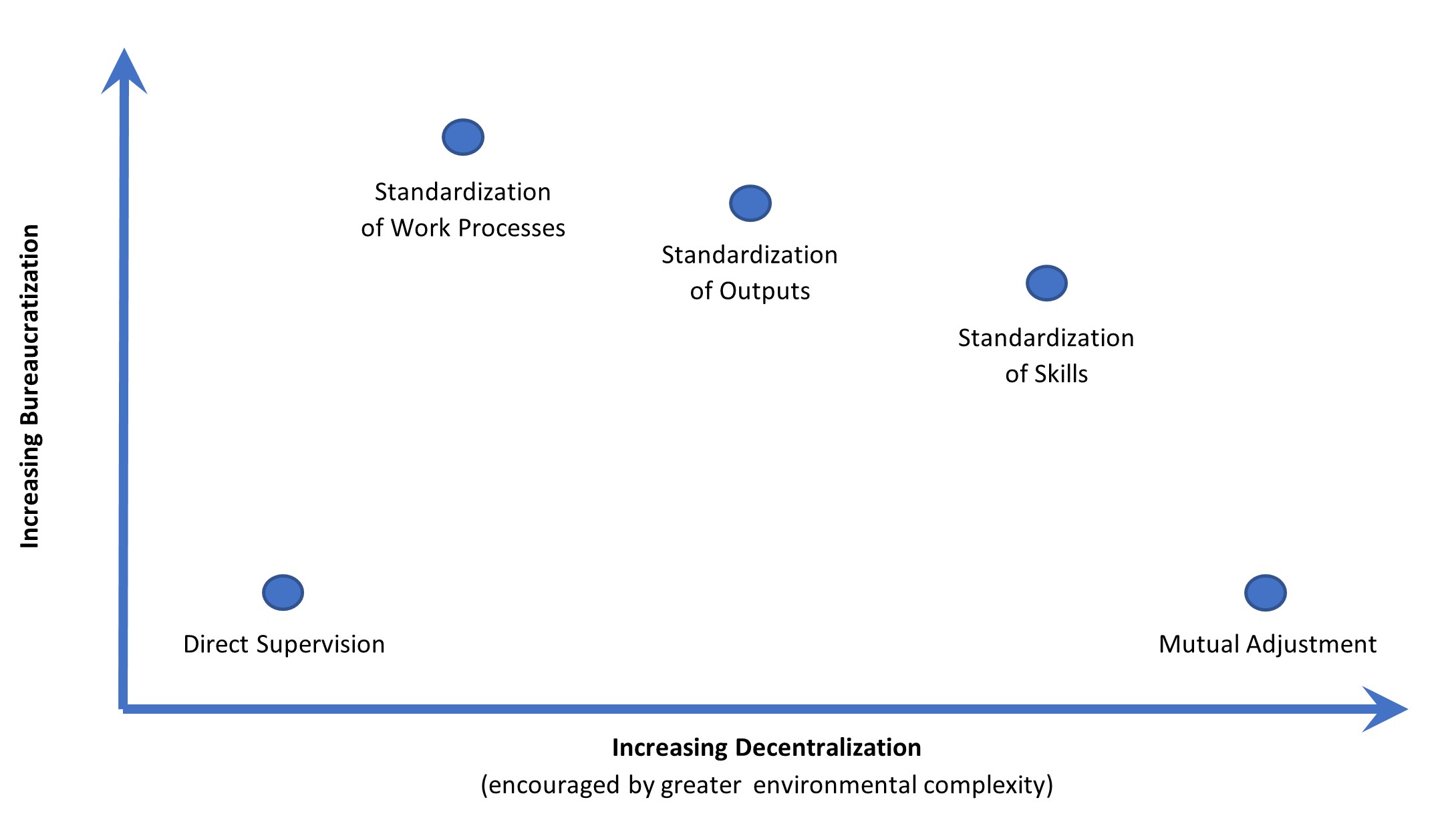
Illustration 1: Types of coordination depending on the level of bureaucratization and decentralisation (Mintzberg, 1983)
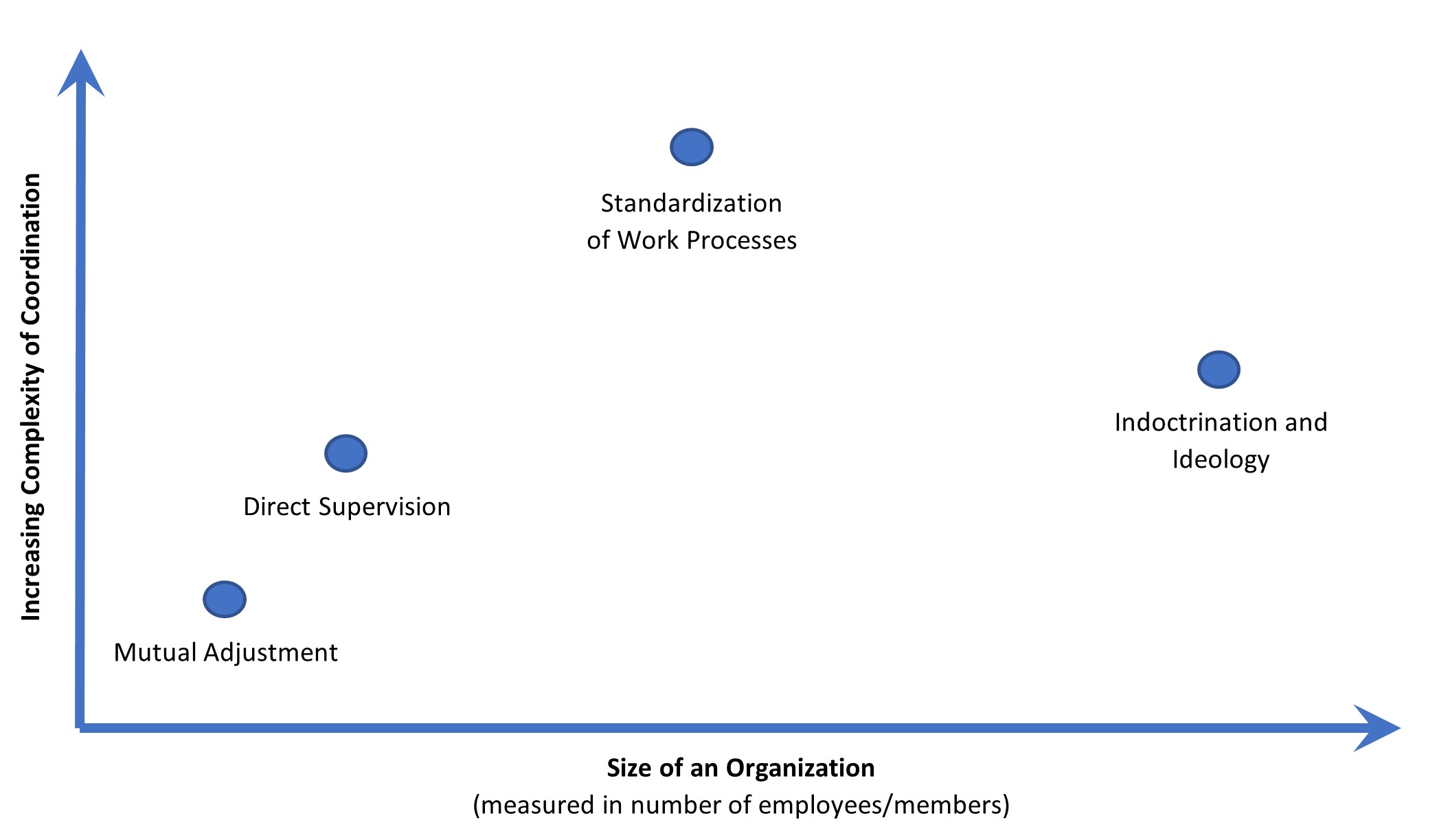
Illustration 2: Types of coordination depending on the size of an organisation